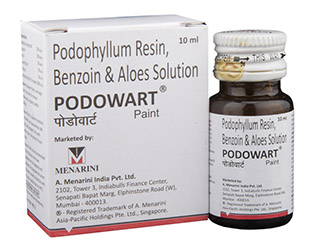
Podowart (Podophyllum Resin): Comprehensive Patient Information for Australia
Basic Product Information
| International Non-Proprietary Name (INN) | Podophyllum resin |
|---|---|
| Australia Brand Names | Podowart, Wart-Off Paint, Condyline (related compound: podophyllotoxin) |
| ATC Code | D06BB04 |
| Available Forms and Strengths | Topical solution, most commonly 10% (100 mg/mL) |
| Manufacturers | Various Australian and international pharmaceutical companies |
| Prescription Status (Australia) | Pharmacist-only (Schedule 3) or Prescription (Schedule 4) for some products |
Mechanism of Action
In simple terms: Podowart contains podophyllum resin, which works by stopping the growth of certain cells—especially skin cells infected by viruses that cause warts. It essentially destroys the tissue of the wart so your body can clear it away.
For specialists: Podophyllum resin is a cytotoxic agent that exerts its therapeutic effect primarily through the inhibition of mitosis in metaphase, by binding to tubulin and arresting microtubule assembly. Its action leads to necrosis and sloughing of affected epidermal tissues, particularly targeting human papillomavirus (HPV)-infected cells in anogenital and plantar warts.
Pharmacokinetics
- Absorption: Minimal systemic absorption when used as directed on intact skin. Absorption may increase with use on large or ulcerated areas.
- Metabolism: Limited data; presumed hepatic breakdown when absorbed systemically.
- Elimination: Metabolites primarily excreted via the kidneys.
- Duration of Action: Lesion necrosis occurs over a few days post-application. Repeated administration is typically required weekly for 4–6 weeks.
Use in Everyday Life and Best Practices
Podowart is commonly used in Australia for the treatment of external warts, including genital warts and plantar warts. It is a topical medicine, applied directly to the wart using an applicator or cotton bud. Most patients are instructed to apply Podowart once weekly in a clinic setting or occasionally at home, as guided by their doctor or nurse.
How to Use Podowart: Step-by-Step
- Clean and thoroughly dry the wart(s) and surrounding skin.
- Apply a small amount of Podowart solution to each wart using the provided applicator, avoiding healthy skin.
- Allow the solution to dry. If advised, you may cover the area with a bandage.
- After 1–4 hours (as per your doctor’s advice), wash the area with soap and water to remove any remaining medicine.
- Repeat once weekly, unless your healthcare provider gives different instructions.
- Continue treatment until warts are gone or for a maximum duration specified by your doctor (usually up to 6 weeks).
Best Practices in the Australian Context
- Genital wart treatment may be performed in sexual health clinics or under GP supervision.
- Protect hands with gloves to avoid accidental application.
- Do not use on mucous membranes (inside vagina, anus, mouth) unless specifically prescribed.
- Do not use on open wounds or ulcerated skin.
- Keep out of reach of children and avoid eye contact.
Dosing: Morning vs Evening
- Podowart can be applied at any time of day, but some people find it easiest to use in the evening.
- Advantages of Evening Use: Allows the solution to dry overnight, reducing transfer to clothing or others.
- Morning Use: May be preferable if you will be supervised in a clinic (e.g., sexual health service); ensures immediate removal after the instructed time.
- Consistency helps – try to apply on the same day each week, setting a calendar reminder if needed.
Taking with Food or Empty Stomach
As Podowart is a topical treatment, it does not interact with food or beverages. You may use it regardless of meals. This is beneficial within the typical Australian lifestyle where meals and snacks are variable.
Interaction Warnings
| Substance | Interaction | Advice |
|---|---|---|
| Alcohol | No direct interaction, but avoid applying Podowart to alcohol-affected skin as alcohol may increase irritation | Use as usual |
| Other topical wart treatments (salicylic acid, imiquimod, cryotherapy) | May increase irritation/skin damage if used together | Do not overlap treatments unless advised by your doctor |
| Immunosuppressant medications | Reduced response to treatment | Discuss with your GP or specialist |
| Open wounds/ulcerated skin | Increased systemic absorption may occur | Do not use on broken skin |
Indications
| Indication | Status | Notes |
|---|---|---|
| External genital warts (condylomata acuminata) — adults | Approved | Main indication in Australia |
| Plantar warts (verruca plantaris) | Off-label | Used when other treatments fail |
| Non-genital cutaneous warts | Off-label | Clinical discretion required; use alternatives first |
Dosing According to Clinical Indications
| Population | Indication | Dosage | Frequency |
|---|---|---|---|
| Adults | Genital warts | Apply small amount directly to wart(s), max 0.5 mL per session, max 10 cm² | Once weekly (under healthcare supervision or as self-care if trained) |
| Children (over 12) | Genital warts | As above | Only under specialist recommendation |
| Elderly | Genital warts | As above but with increased skin monitoring for adverse reactions | Once weekly |
| All | Plantar/non-genital warts | Apply to wart(s) only, as directed | Off-label use; monitor for irritation |
Safety Profile and Side Effects
| Frequency | Side Effect | Advice |
|---|---|---|
| Common | Redness, mild pain or burning, swelling, itching at treatment site | Usually mild, temporary; resolve without action |
| Uncommon | Blistering, skin ulceration, delayed healing | Stop and contact your GP if severe |
| Rare | Allergic reaction (swelling, hives, difficulty breathing) | Seek emergency care |
| Overdose or improper use | Systemic toxicity (nausea, vomiting, confusion, nerve problems) | Urgent medical review required |
Warnings:
- Do not use if you are pregnant or breastfeeding without medical advice.
- Do not use on mucous membranes (inside mouth, vagina, anus, or eyes).
- Keep away from children and pets.
Guidelines for Proper Use
- Always follow your doctor or pharmacist’s instructions closely.
- If you miss a dose, resume your schedule at the next planned application—do not double up.
- Store at room temperature, away from direct heat and sunlight.
- Dispose of any unused medicine carefully per local pharmacy guidelines.
- Never use on large areas or for longer than prescribed.
- If you notice severe redness or pain that does not improve, stop applying and seek medical advice.
Alternative Treatment Options in Australia
- Imiquimod cream: Immunomodulator, used for external genital and perianal warts. Pros: self-applied, less tissue damage. Cons: longer treatment time, more expensive.
- Salicylic acid preparations: Available over the counter for common warts. Pros: easy, cheap. Cons: less effective for genital warts.
- Cryotherapy (freezing): In-clinic or pharmacy treatment. Pros: usually rapid, well tolerated. Cons: multiple visits, possible blistering/scarring.
- Surgical removal/laser ablation: Used in resistant cases. Pros: rapid. Cons: invasive, possible scarring.
Most are listed under the Pharmaceutical Benefits Scheme (PBS) for eligible patients. Discuss with your healthcare provider for personalised recommendations.
Legal, Registration, and Reimbursement Status in Australia
- Registered with the Therapeutic Goods Administration (TGA).
- Available via pharmacist ("Pharmacist Only Medicine" S3) or by prescription ("Prescription Only Medicine" S4), depending on product.
- Not usually reimbursed for wart treatment, except in some sexual health clinics or with concession status.
- Some alternative therapies (e.g., imiquimod) may be PBS-subsidised for specific indications.
Latest Research and Clinical Guidance (2022–2025)
- According to Australian Therapeutic Guidelines: Sexual and Reproductive Health (2023), podophyllum resin remains a first-line, short-course option for certain external genital warts.
- Recent reviews (Wilkinson et al., 2023, J Eur Acad Dermatol Venereol) confirm similar efficacy to podophyllotoxin (self-applied) but highlight the importance of health professional supervision due to risk of skin toxicity.
- No major changes to PBS or TGA recommendations as of 2024.
Availability and Delivery
Podowart and similar podophyllum resin solutions are available in:
- 10 mL and 15 mL dropper bottles
- Retail price: typically $20–$40 AUD per bottle (unsubsidised)
| City | Estimated Pharmacy Delivery (Business Days) | Click & Collect |
|---|---|---|
| Sydney | 1–2 | Same-day available at selected pharmacies |
| Melbourne | 1–2 | Same-day |
| Brisbane | 2–3 | 1 day |
| Perth | 3–4 | 1–2 days |
| Adelaide | 2–3 | 1 day |
Frequently Asked Questions (FAQ)
- Can I apply Podowart myself at home?
In many cases, yes—but always use Podowart under the supervision of your doctor, especially for genital or large warts. You will be shown precisely how to use it and how to avoid skin irritation. - How long will it take for the wart(s) to clear?
Most warts respond within 4–6 weekly treatments. If warts persist longer, consult your doctor about alternative therapies. - Is Podowart safe to use during pregnancy or breastfeeding?
Podophyllum resin can be absorbed and may cause harm to unborn children. Do not use during pregnancy or breastfeeding unless specifically prescribed by your healthcare provider. - Can I use Podowart on more than one wart at a time?
Yes, but never exceed the maximum treatment area (usually 10 cm² or 0.5 mL per application). Applying to too many warts or too large an area increases the risk of serious side effects. - What should I do if I get Podowart on healthy skin?
Wash the affected area with soap and water immediately. If irritation persists or is severe, contact your pharmacist or GP.