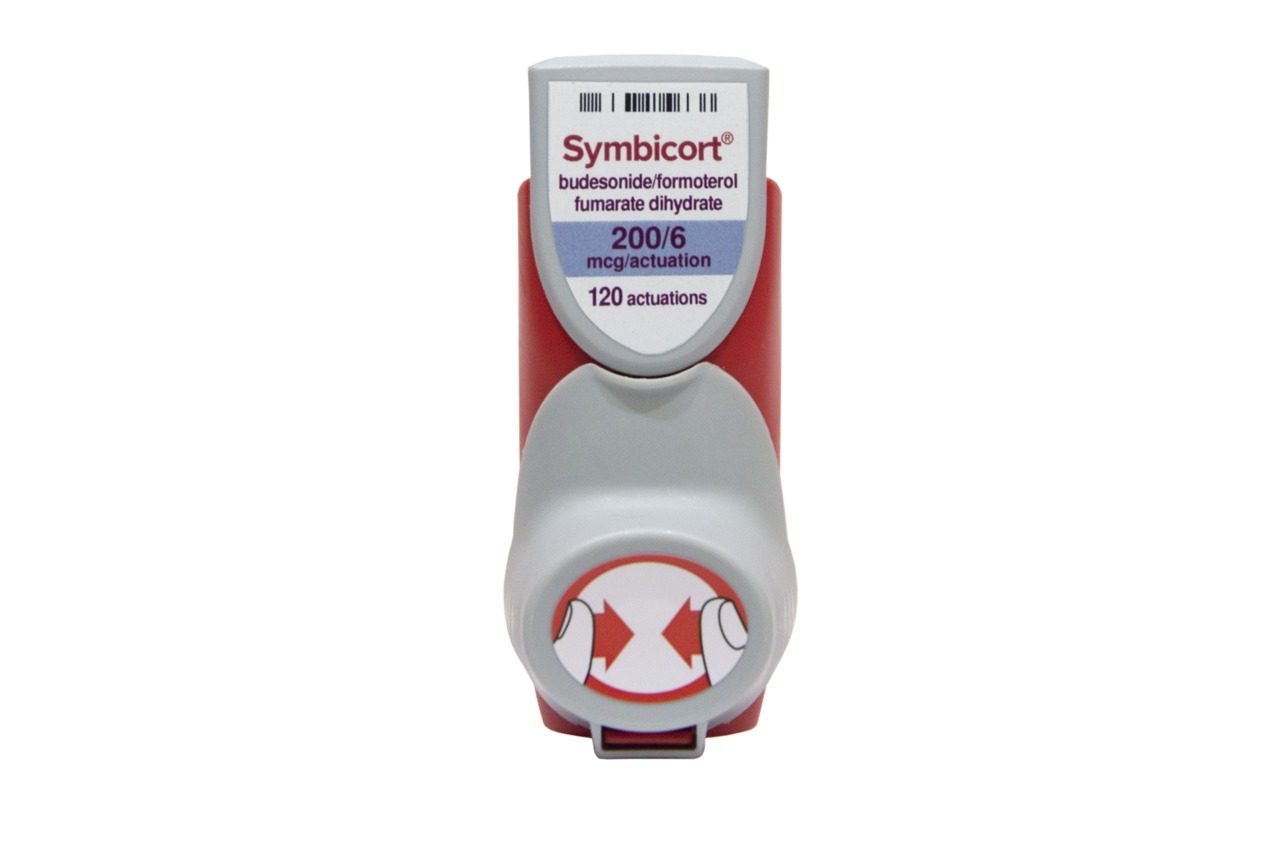
Symbicort (Powder Form): Budesonide / Formoterol Fumarate Dihydrate
Basic Product Information
| Active Ingredients | Budesonide / Formoterol Fumarate Dihydrate |
|---|---|
| Australia Brand Names | Symbicort Turbuhaler, Symbicort Rapihaler |
| ATC Code | R03AK07 |
| Available Forms & Strengths |
|
| Manufacturers | AstraZeneca Pty Ltd |
| Prescription Status | Prescription only (Schedule 4; S4) |
Mechanism of Action
For Patients: Symbicort is a combination inhaler containing two medicines: budesonide reduces inflammation in the airways, and formoterol helps to quickly open up the breathing tubes to make breathing easier. Using them together can both prevent and relieve asthma or COPD symptoms.
For Specialists: Budesonide is a corticosteroid with strong local anti-inflammatory properties, reducing airway hyperresponsiveness by decreasing cytokine and inflammatory cell infiltration. Formoterol is a long-acting β2-agonist (LABA) that induces bronchodilation via selective stimulation of β2-adrenergic receptors, resulting in smooth muscle relaxation within minutes. This combination is intended for both maintenance and reliever therapy in asthma, as per the SMART (Single Maintenance and Reliever Therapy) approach.
Pharmacokinetics
- Absorption: Budesonide and formoterol are rapidly absorbed through the lungs. Peak plasma concentration is typically reached within 15–30 minutes.
- Metabolism: Budesonide undergoes extensive first-pass metabolism in the liver (via CYP3A4), reducing systemic exposure. Formoterol is metabolised primarily in the liver via direct conjugation.
- Elimination: Budesonide and metabolites are mainly excreted via urine; formoterol is excreted both renally (<10%) and in faeces. Elimination half-life is 2–3 hours for budesonide and 8–10 hours for formoterol.
- Duration of Action: Formoterol’s bronchodilatory effect persists for at least 12 hours; budesonide's anti-inflammatory effect lasts with regular use.
Use in Everyday Life and Best Practices
Symbicort is suitable for adults and children over 12 years for asthma, and adults for COPD. The powder form (Turbuhaler) is breath-activated, easy to use, and portable.
- Usual Adult Dose for Asthma (Maintenance): 1–2 inhalations twice daily. Alternatively, your doctor may prescribe it both as a regular daily treatment and as-needed (reliever) therapy.
- For COPD: 2 inhalations twice daily.
- Children (≥12 years): As for adults, under medical supervision.
- Use: Exhale gently, place mouthpiece between lips, inhale deeply and forcefully, hold breath for a few seconds, then exhale slowly. Never shake Turbuhaler.
- Regularity: Best used at the same time(s) each day. Store below 30°C and protect from moisture.
- Replace cap securely after use.
Dosing in the Morning vs Evening
- Standard dosing is twice daily (morning and evening), aiming for even coverage over 24 hours.
- Some patients may prefer inhaler use with their morning and evening routines for adherence.
- Consistency is key — missing a dose may reduce symptom control. Use a phone reminder or keep your inhaler in a visible, convenient place.
- For once-daily dosing (as directed by your doctor), use at the same time each day, ideally in the evening if night-time symptoms are troublesome.
Taking with Food or on an Empty Stomach
- Meals do not significantly alter the effectiveness of Symbicort since it acts directly on the lungs, not via the gut.
- You may use Symbicort with or without food, regardless of diet preferences (including traditional English or multicultural Australia diets).
- After inhaling, rinse your mouth with water and spit it out to reduce the risk of oral thrush — this is safe whether before or after eating.
Interaction Warnings
| Substance/Group | Interaction Risk | Advice |
|---|---|---|
| CYP3A4 inhibitors (e.g. ketoconazole, ritonavir) | Increased budesonide blood levels, risk of side effects | Monitor closely; dose adjustment may be required |
| Beta-blockers (e.g. propranolol) | Reduced effect of formoterol | Avoid unless essential; use with caution |
| Other long-acting beta-agonists (LABAs) | Risk of overdose, increased side effects | Do not use simultaneously with another LABA |
| Diuretics (e.g. furosemide) | Increased risk of low potassium | Monitor potassium if used together |
| Alcohol | May worsen side effects (tremor, palpitations) | Limit or avoid excessive consumption |
| Grapefruit or grapefruit juice | May increase budesonide levels | Occasional use unlikely harmful, but avoid daily large quantities |
Indications
| Indication | Status |
|---|---|
| Asthma (maintenance treatment & as-needed reliever) | Approved |
| Chronic Obstructive Pulmonary Disease (COPD) | Approved (adults only) |
| Exercise-induced bronchospasm | Off-label |
Dosing According to Clinical Indications
| Population | Asthma (Maintenance/Reliever) | COPD (Maintenance) |
|---|---|---|
| Adults (18+) | 1–2 inhalations (100/6 or 200/6), twice daily or as directed Max. 12 inhalations/day (as reliever) | 2 inhalations (200/6), twice daily |
| Adolescents (12–17 years) | 1–2 inhalations, twice daily; as-needed under medical supervision | Not approved |
| Elderly (65+ years) | As for adults; monitor for side effects | As for adults |
Safety Profile / Side Effects
| Type | Side Effect | How Common? |
|---|---|---|
| Common | Oral thrush, hoarse voice, sore throat, headache, tremor, palpitations | 1–10% |
| Less common | Increased heartbeat, muscle cramps, cough, agitation, sleep disturbance, mild allergic reactions | <1% |
| Rare/Serious | Paradoxical bronchospasm, severe allergic reactions, adrenal suppression (long-term use) | <0.1% |
- Rinse mouth and spit water after use to reduce risk of oral thrush.
- If you experience chest tightness or difficulty breathing after inhaling, seek medical help immediately.
- Report any unexplained bruising, vision changes, or weakness to your doctor.
Guidelines for Proper Use (Australia Context)
- Receive training from your pharmacist or asthma clinic on the correct inhaler technique. Demonstrate and ask for feedback regularly.
- Use a personal asthma action plan, as recommended by the National Asthma Council Australia.
- Always carry your reliever inhaler (e.g. Symbicort if using SMART therapy or a separate salbutamol device) in case of sudden symptoms.
- Keep track of doses left in your Turbuhaler. If you see a red marker in the dose window, arrange a refill soon.
- Do not stop or change your dose without consulting your GP.
- During pollen season or bushfire alerts, monitor air quality and adjust activities as advised by local health authorities.
Alternative Treatment Options
- Seretide (fluticasone/salmeterol): Dry powder or MDI, similar uses, PBS reimbursed. May be preferred if sensitivity to budesonide exists. Slightly slower onset than formoterol-based combinations.
- Breo Ellipta (fluticasone furoate/vilanterol): Simple once-daily inhaler, PBS subsidised. Pros: convenient. Cons: not suitable for as-needed use in SMART therapy.
- Fostair (beclometasone/formoterol): Available as MDI; requires private prescription.
- Salbutamol (Ventolin, Asmol): Short-acting reliever only, not a preventer, for breakthrough symptoms.
- Trixeo Aerosphere (formoterol/ glycopyrronium/ budesonide): For selected COPD patients; specialist prescription.
Legal, Registration, and Reimbursement Status in Australia
- Regulator: Therapeutic Goods Administration (TGA)
- Legal classification: Prescription Only Medicine (S4).
- PBS (Pharmaceutical Benefits Scheme): Symbicort is listed for chronic asthma and COPD if PBS criteria are met. Patients pay a subsidised price (concession/pension rates available).
- Available throughout Australia in pharmacies following presentation of a valid prescription.
Latest Research & Clinical Guidance (2022–2025)
- Australian Asthma Handbook (2024): Supports SMART therapy with Symbicort for moderate to severe asthma. Reduces flare-ups and steroid exposure compared to traditional fixed-dose regimes (asthmahandbook.org.au).
- Global Initiative for Asthma (GINA 2024): Endorses budesonide/formoterol as both maintenance and reliever across most ages, due to rapid onset and strong evidence for reducing severe attacks.
- Recent trials: Ongoing studies are assessing safety of lower-dose strategies, role in mild asthma, and comparative effectiveness in diverse populations (pubmed.ncbi.nlm.nih.gov).
Availability and Delivery
| Pack Size | Approximate PBS Price (2024) | Expected Delivery (Metro/Regional/Remote) |
|---|---|---|
| 60-dose Turbuhaler | $30.00–$41.00 (PBS subsidised) | Sydney: 1–2 days Melbourne: 1–2 days Brisbane: 2 days Perth: 2–3 days Regional/Remote: 3–6 days |
| 120-dose Turbuhaler | $48.00–$55.00 (PBS subsidised) | As above |
- Prices may vary slightly between pharmacies and with PBS eligibility.
- Urgent deliveries or weekend/holiday dispatch may incur additional fees—enquire with your pharmacy.
Frequently Asked Questions (FAQ)
- Can I use Symbicort as both my daily and reliever inhaler?
Yes, if your doctor has prescribed SMART (Single Maintenance And Reliever Therapy). Do not use other relievers unless advised. - What should I do if I forget a dose?
Take it as soon as you remember, unless it’s nearly time for the next dose; never double up to make up a missed dose. - Can I use Symbicort while pregnant or breastfeeding?
Discuss with your doctor. Generally, asthma control is important in pregnancy, and Symbicort is often considered safe if needed. - How do I know if my inhaler is empty?
The dose indicator window turns red when 20 doses remain, and zero when empty. Discard and replace the device at this point. - Can Symbicort be used in emergencies?
If using the SMART regimen, yes, you can take extra doses for acute symptoms. For severe asthma attacks that don’t improve, seek emergency help (dial 000).
References
- Australian Asthma Handbook. National Asthma Council Australia. 2024. asthmahandbook.org.au
- Therapeutic Goods Administration (TGA), Australia. Symbicort Product Information. ebs.tga.gov.au
- Pharmaceutical Benefits Scheme Schedule. 2024. pbs.gov.au
- Global Initiative for Asthma (GINA) 2024. ginasthma.org